Pushing Dexterity and Safety for In-Hand Object Pose Reaching That Works Remarkably Well
Try the policy in your browser
The deployed policy and safety filter, running live. Move the goal, turn the wrist, or drag the object to push it.
Run the policy live
MuJoCo in your browser · about 16 MB
Abstract
Dexterous manipulation with multi-fingered hands is the next frontier of robotics, yet learned hand skills remain limited to simple grasps or basic repeated motions, such as rotating an object. As robots attempt more demanding in-hand maneuvers, safety, such as not dropping the object, becomes critical, yet it is rarely measured. We study in-hand object pose reaching, a task that demands diverse and difficult grasps: moving an object to any position and orientation relative to the hand, at any wrist orientation, through long sequences of consecutive goals. We present a recipe for training such policies for a LEAP hand in simulation without human data, built on a range of insights, from diverse resets and goals via generated grasp datasets to an adaptive friction curriculum. With careful system identification, the policies transfer zero-shot to the real hand, using either motion capture or a single wrist-mounted depth camera, and prove remarkably capable and robust. On top of the task policy, we add a learned residual safety filter with adjustable conservativeness, letting us tune the balance between performance and safety and greatly reduce object drops. In 13.3 hours of real-robot evaluation over 4,800 unseen goals across 4 objects and diverse wrist orientations, the state-based policy reaches 95% of goals within 2 cm and 0.4 rad, and the filter cuts its drops by 75% at a cost of 3.7 points of success. The policies can also spin a lightbulb held in an arbitrary pose, reach out-of-distribution goals, withstand fast arm motion and perturbations, and, needing only a wrist camera, serve as portable skills such as screwing in a lightbulb. We release the full recipe as a platform for studying performance, reliability, and safety in high-dimensional dexterous systems.
Any wrist orientation
Evaluated at these six wrist orientations.
Ten consecutive goals per orientation
4,800 goals, all on video
96 runs of 50 consecutive unseen goals, 10 s each: 4 objects × 6 wrist orientations × state or depth policy × with or without the filter.
Results table
| Policy | Object | Filter | Precise /300 | Coarse /300 | Drops /300 | Time to 1st drop (s) | Reached before 1st drop /50 | Avg. action change |
|---|---|---|---|---|---|---|---|---|
| State | Lightbulb | none | 277 | 297 | 2 | 427 | 42.3 | – |
| ResSafe | 268 | 292 | 0 | 500 | 48.7 | 8.5% | ||
| Rubber duck | none | 255 | 291 | 7 | 298 | 29.3 | – | |
| ResSafe | 194 | 262 | 2 | 441 | 39.2 | 15.4% | ||
| Knife | none | 234 | 288 | 4 | 257 | 24.7 | – | |
| ResSafe | 216 | 281 | 1 | 470 | 44.5 | 9.3% | ||
| Wineglass | none | 141 | 266 | 3 | 352 | 30.8 | – | |
| ResSafe | 128 | 263 | 1 | 449 | 39.2 | 8.9% | ||
| Depth | Lightbulb | none | 191 | 284 | 3 | 371 | 35.2 | – |
| ResSafe | 183 | 278 | 0 | 500 | 46.3 | 7.4% | ||
| Rubber duck | none | 152 | 264 | 12 | 268 | 23.5 | – | |
| ResSafe | 95 | 233 | 2 | 392 | 30.3 | 13.1% | ||
| Knife | none | 60 | 163 | 22 | 163 | 9.0 | – | |
| ResSafe | 53 | 146 | 4 | 406 | 22.0 | 6.6% | ||
| Wineglass | none | 56 | 151 | 51 | 111 | 3.7 | – | |
| ResSafe | 50 | 143 | 40 | 117 | 5.5 | 6.6% |
Each row pools 6 runs (one per wrist orientation). Precise: 1 cm / 0.2 rad; coarse: 2 cm / 0.4 rad. Filter at w = 0.5.
Explore every run
Pick a run: watch all of its goals at once, one tile per goal, or the whole run as a timelapse.
Trained in simulation, transferred zero-shot
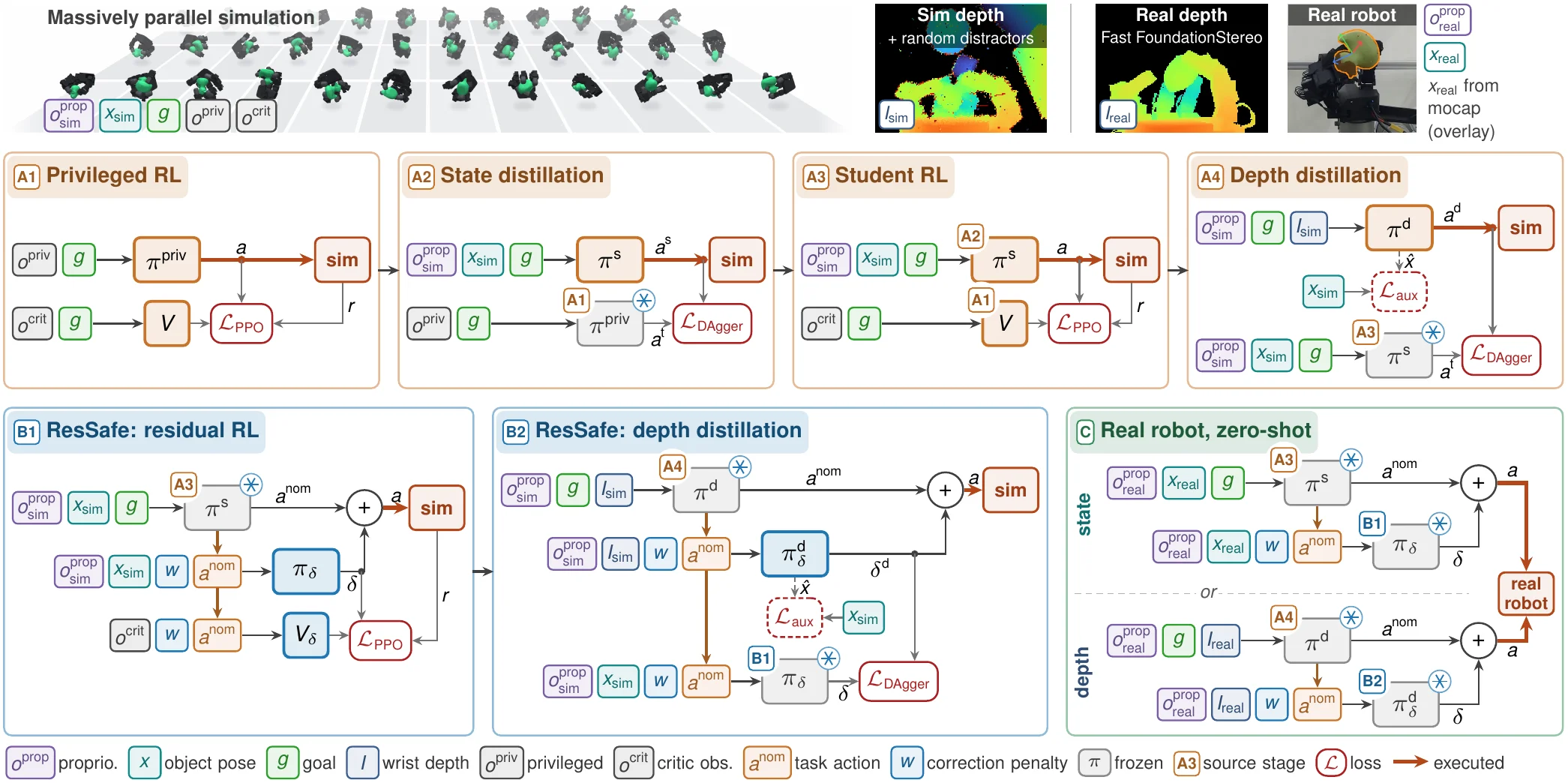
No human data: grasps and goals come from generated datasets. A privileged teacher is distilled into a motion-capture (state) student and a wrist-camera (depth) student, and a residual safety filter is learned on top.
A safety filter that prevents drops
ResSafe adds a small learned correction to the policy's action, trained only to keep the object in hand. On the real robot it cuts the state policy's drops by 75%.
Beyond the benchmark
Spinning a lightbulb
Out-of-distribution goals
Goals moved by hand
Physical disturbances
Depth policy, no filter: fingers pulled away, then the object pushed into the palm.
Unseen arm motion
The arm swings the wrist for 30 s while the object turns at its goal (depth policy, wrist-camera inset). Pick any trial.
Lightbulb
Rubber duck
Multi-step tasks with only a wrist camera
The depth policy as a skill, with scripted arm motions. No motion capture, no external cameras.
Rubber duck: grasp, reorient, place
Wineglass: pick up, flip, flip back
Lightbulb: regrasp, screw in
Every trial. The filter runs at w = 1.5 in these tasks.
BibTeX
@misc{chuang2026dexsafe,
      title={Pushing Dexterity and Safety for In-Hand Object Pose Reaching That Works Remarkably Well},
      author={Ian Chuang and Hiya Shah and Vamsi Chilamkur and Iman Soltani and Claire Tomlin},
      year={2026},
      eprint={2610.37652},
      archivePrefix={arXiv},
      primaryClass={cs.RO},
      url={https://arxiv.org/abs/2610.37652},
}